
Bats Taking Flight
Donors
Bats Taking Flight
Mexican Free-Tail Bats
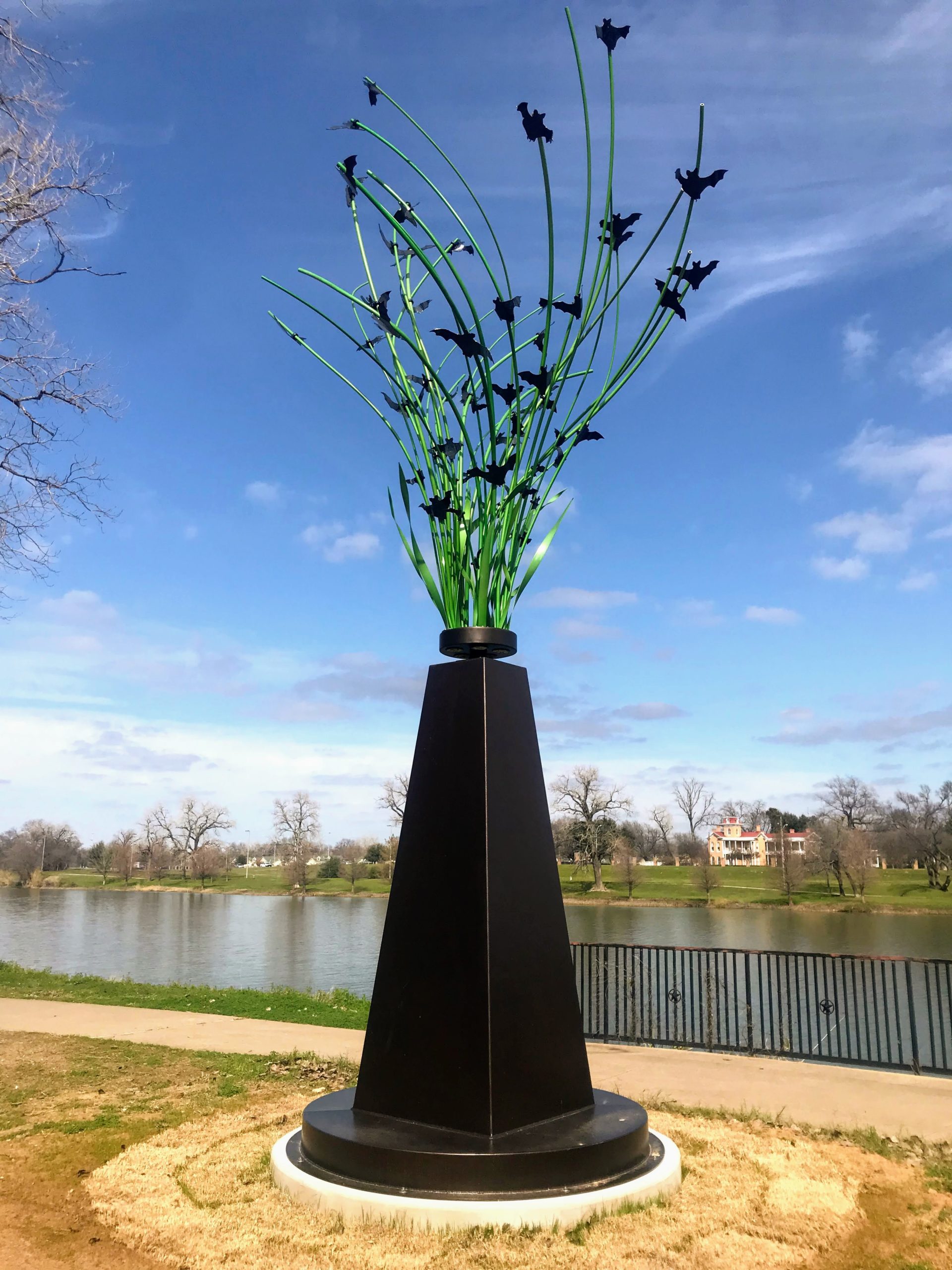
As an artist, Bryant J. Stanton likes to observe nature and draw inspiration from what he sees. He is particularly drawn to patterns in nature, divine proportions, and the Fibonacci sequence. The coordinated, frantic, serpentine flight patterns of Mexican Free-Tail bats interested Stanton, as they fly out in an orchestrated swirl into the night sky.
His piece, Bats Taking Flight, plays on the wind moving the silhouetted bats about on long sinuous tubes of aluminum striking neighboring tubes, and generating ‘tinny-clanking’ sounds.
The silhouetted bats are painted with a reflective, deep-blue color, representing bats at dusk. The reflective paint picks up on ambient light, headlights of passing cars, and beams from flashlights, all bouncing off of the painted bats and reeds. The bouncing, reflected light, contrasted against the dark park surroundings, appear as illuminated bats flying about.
In creating this piece, Stanton enlisted the help of John Nickell and George Johns with Nickell Metalsmiths in Waco.
Did You Know?
- There are over 1,400 species of bats worldwide and bats can be found on nearly every part of the planet expect extreme deserts and polar regions.
- Not all bats hibernate! Some bat species survive by migrating in search of food to warmer areas when it gets chilly.
- Bats have very few natural predators and their biggest threat is actually disease
- Without bats, bananas, avocados, and mangos would most likely cease to exist as they depend on bats for pollination. Bats also spread seeds for nuts, figs, and cacao.
- Bats are the only living true flying mammal and are very fast at it! Some bats can reach speeds of over 100 miles per hour.
- There are wild bat colonies up and down the banks of the Brazos River. If you want to see live bats up close, there is a very cool bat cave enclosure at Cameron Park Zoo.
Did You Know?
About the artist
Waco artist Bryant J. Stanton got his start in stained glass in the late 1970s making suncatchers. After a year, he started his own company at the age of 21 called Stanton Glass Studio. Bryant’s first commercial job came from restoring stained glass windows from a church that was damaged by a fire. Stanton’s studio has grown to become nationally recognized with works in homes, churches and businesses across Texas and the United States. Stanton has much more experience than just glass, and specializes in working with wood and metal, too. You can see several examples of his work in famous buildings. Here in Waco, you may have noticed the “Green Door” on the 8th block of Austin Avenue, and the DNA double helix sculpture in the science building at McLennan Community College.
More sculptures
Explore more animal sculptures along the river trail. Each piece brings a different story, artist, and perspective to the Waco Sculpture Zoo.